
Central Transit Project
Transcending CA's California's High Speed Rail
This required a lot of planning and innovation.
The project sprouted as a question in the mid-1990s when the rail-line from Fresno through Clovis was converted from an abandoned railroad into a jogging path. The train company had gone out of business decades ago and the line was abandoned. A question arose about the abandoned rail Rights-of-Ways. With more urban growth, the greater its need for an alternative mode of transportation; like light-rail.
Where does a project like this begin? Since that rail-line was once used for transportation, how is the growing metropolitan's transportation demand for a transit system going to be achieved? An answer to meet the growing transportation demand had to be found from another question: "How can this be accomplished without overwhelming costs and bloated tax burden?"
The answer required several years of time, research, financing, planning and innovation.
The Central Transit project integrates a new technology transit system into the area's existing corridors. The project's methodology doesn't replace the automobile, it provides a convenient and quick alternative mode of transportation for Valley residents and visitors. The intent and mission of this project is to improve quality of life for every Valley citizen.
New Technology Transit
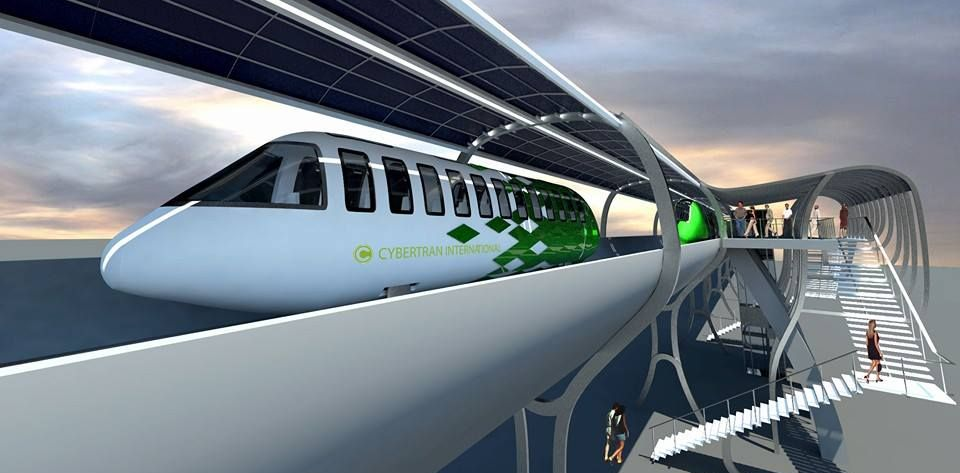
This is ultra-light-rail technology. Its technologically advanced computer logistics guidance system allows each passenger to be taken directly to their destination.
- Modern transportation solution
- Electrically powered by solar panels above track which provide shade
- project designed as privately funded Public/Private Partnership
- Without additional government tax increase
- Convenience and affordability
- An actual sustainable urban growth solution.
The Project
How the project begins
It begins with a 12-mile section on Highway 41 between Downtown and Children’s Hospital.
Legislation of urban growth
The legislative actions of compressing land space, in the automobile centric land-use design, to restrict automobile movement and eliminate parking, under the guise of reducing vehicle miles traveled (VMT) as a method of “greenhouse gas” compliance; is a foolish act of delusion and ignorance. It’s a blind action that makes automobile centric land-use dysfunctional. Without a transit system to serve an area’s transportation needs, the legislative actions to legislate high-density into the existing automobile centric land-use designs can only serve to over-burden the already stressed and crowded roads.
California legislators lead the global push for environmentalism politics. Its recent bill, Assembly Bill 130 (AB 130, signed into law June 2025) imposes fees on new construction projects based on Vehicle Miles Traveled (VMT). The bill allows local agencies to charge VMT mitigation fees on new residential and commercial developments if the projects exceed local thresholds.
Critics estimate these fees could add $16,000 to $197,000 to the cost of a new home, with some projections suggesting up to $324,000 over a 20-year period, significantly impacting housing affordability. Developers can either pay into the VMT fund or provide alternative mitigation, such as improving local transit or biking infrastructure, to offset the project's transportation impact.
The legislators’ intent for this new influx of revenue is to finance affordable housing near transit, bike lanes, and pedestrian infrastructure to reduce car dependency. How do the burdensome increases in housing costs, create affordability of housing to the automobile centric land-use developed areas?
This is a typical approach of legislative ignorance. Other related legislative actions, such as SB 9, SB 684, SB1123, and SB 79, all apply this same ‘goal’. These new laws allow building 1-10 plexes which override local zoning requirements, and provide State money (grants and cheap loans) for section-8 housing. These new laws are consistently hostile to California’s land-use and serve to cause extensive transportation dysfunction. These legislative actions are impossible applications to automobile centric land-use developed areas. Very few areas in California are built with transit-oriented land-use.
It’s simply that legislators are ignorant of the simple understanding that ALL urban growth is founded upon its primary source of transportation. California’s primary source of transportation is the automobile. If they want to legislate transit oriented urban growth, they must first build viable and modern fixed-rail transit technology systems.
These local transit systems have to be integrated locally and regionally. Hundreds of miles in allocated light-rail Rights-of-Ways already exist throughout California to make both possible and practical for urban growth.