Complexity of Subatomic Motion
What is involved with subatomic motion
photos: PsHere.com
Although life is reliant upon the fundamentals of relativity, it’s a subject that is irrelevant to society and extremely controversial, with highly opinionated perspectives, in the scientific community. Societal psychology is inherently intimidated by contemplative understanding of theoretical physics. Questions of infinitesimally small particles, how they move, or considering the immense mass of the universe’s infinite expanse; these are thoughts and conversations which are out of the realm of normal existence. Considering such topics, are odd; challenging and provide a missing component for reward. Conversations regarding politics and religion garner much greater interest and even emotional volatility.
With that intro, what’s the point of this article? There is an importance for advancing transportation. Delving into the realm of theoretical logic, the topic seeks practicality for ideas from physics.
Rotational spin has momentum, the question is: how and why? Relativity. To what? Einstein’s general theory of relativity: that all matter is moving at the speed of light. Therefore, all matter holds potential energy of motion. Energy is temperature change and nature’s centripetal motion. Heat is generated by the force of centrifugal motion.
The practical applications of theoretical physics have tremendously important value. It’s similar to clicking on a switch to turn on a light. People just want the light, very few people have a desire to gain an understanding about the fascinating intricacies of what makes the light work, nor the process of producing power, nor the issues of calculating thermodynamic loss. Society is compelled by entertainment, wants instant results, and no lectures. The philosopher can look in a mirror and contemplate theories.
Having been intimately involved in the advanced transit and sustainable urban growth industry for 30 years, this author is of the opinion that transportation is poised to become the next technological revolution. To reach this position, advances in physics are necessary. There are a plethora of CATTCC articles showing a new theory explaining that gravity is a process of particle motion; rather than a consequence of mass. The articles recognize Schauberger’s analysis that nature is centripetal, and with gravity manipulation; forward motion can be by attraction of mass without friction; rather than by resistance of pushing acceleration.
Nature’s simplicity
To those with interest for the deepest of minute details in relativity and particle mass; the more complex nature appears, the simpler its understanding. This is how John Dearian explained it to this author. John was a nuclear physicist who worked for the DOE, and was one of the PhDs called-in to solve the crisis in 1979 at Three Mile Island. John was the most brilliant human to personally influence this author.
What does this article’s title explain? What is subatomic motion? This article is a continuing study, researching ways to enhance transportation’s future. How subatomic particles move; is foundational to capture the flow of motion. The middle of this article begins by analyzing the distinction between the terms: classical physics, quantum physics, quantum mechanics, and subatomic physics.
The first aspect of differentiation is that social trends carry variations to the meaning of words.
Different attributes to theoretical physics
Here is how AI Imputes its contribution as a plethora of its programmers’ rhetorical hubris.
The Classical physics describes the deterministic behavior of macroscopic objects using continuous variables and Newtonian laws, whereas quantum physics is the broader field studying matter and energy at atomic and subatomic scales where probabilistic rules dominate. Quantum mechanics is the specific mathematical framework and set of laws within quantum physics that formalizes these behaviors. Subatomic physics refers to the physical scale or domain (particles smaller than an atom) rather than a distinct theoretical framework; while subatomic phenomena are governed by quantum mechanics, the term simply denotes the size of the objects being studied.
The key distinctions are:
- Scale and Determinism: Classical physics applies to large, observable systems and assumes precise predictability. Quantum physics/mechanics applies to microscopic systems and relies on probability, wave-particle duality, and quantization.
- Theoretical vs. Descriptive: Quantum mechanics is the theory (the equations and logic), while subatomic physics is the subject (the particles like electrons and quarks). Quantum physics is the umbrella term for the study of these phenomena.
- Measurement: In classical physics, measurements are commutative and do not disturb the system. In quantum mechanics, measurements are non-commutative, leading to the uncertainty principle where the order of measurement affects the outcome.
- Nature of Reality: Classical physics treats particles and waves as separate entities with definite trajectories. Quantum mechanics unifies these into wave functions, allowing for superposition states where particles exist in multiple configurations simultaneously until measured.
To get a through explanation, we’ll have AI provide an individualized section for each of the different topics. Classic physics presents a variation of subatomic physics; with the rational of understanding the acknowledgement: that in all things is GOD. Classical physics assumes all points in the universe contain Aether as a universal component of presence that is unseen.
To continue with AI’s long and wordy explanations.
Classical physics
In classical science and alchemy, Aether was considered the fifth element or quintessence, a pure, immutable substance that filled the universe beyond the terrestrial sphere and composed the celestial spheres. During the 19th century, physicists postulated the existence of a luminifer ous aether as a weightless, frictionless medium permeating all space, which was believed necessary for the propagation of light waves. This scientific theory was effectively disproven by the Michelson–Morley experiment in 1887, which failed to detect any "aether wind," leading to the development of Einstein's theory of special relativity, which established that light can travel through a vacuum without a physical medium.
Realistically, Aether is what carries the ethernet. It is that which is the unknown motion of the unseen subatomic existence. It is what Einstein postulated with his general theory of relativity.
The existence of the Aether is the philosophical perspective in classical theoretical physics. Even with the flaws in classical physics, there is just as much to its validity with the philosophical perspective, then in modern intellectualism and math manipulation in quantum mechanics.
Quantum physics
The AI description:
Quantum physics (also known as quantum mechanics) is the branch of physics that describes the behavior of matter and energy at the most fundamental, atomic, and subatomic scales. Unlike classical physics, which governs our everyday macroscopic world, quantum physics reveals that particles like electrons and photons exhibit wave-particle duality, meaning they possess characteristics of both discrete particles and continuous waves.
Key principles defining this field include:
- Quantization: Energy and momentum exist in discrete, indivisible units called quanta rather than continuous values.
- Superposition: Particles can exist in multiple states or positions simultaneously until they are measured or observed.
- Uncertainty Principle: There are fundamental limits to how precisely certain pairs of properties, such as position and momentum, can be known simultaneously.
- Entanglement: Particles can become interconnected such that the state of one instantly influences the other, regardless of distance.
Developed in the early 20th century by scientists including Max Planck, Albert Einstein, Niels Bohr, Werner Heisenberg, and Erwin Schrödinger, quantum mechanics is not just theoretical; it underpins modern technologies such as lasers, transistors, MRI machines, and cell phones.
Quantum mechanics
More with AI’s indulgent hubris.
It’s the numbers. Quantum mechanics is the fundamental branch of physics that describes the behavior of matter and energy at the atomic and subatomic scales, where classical physics fails. It is built on the principle of wave-particle duality, which states that particles like electrons and photons exhibit properties of both discrete particles and continuous waves.
Key characteristics include:
- Quantization: Physical properties such as energy and momentum exist in discrete, specific units called "quanta" rather than a continuous range.
- Probability: The theory uses a wave function to calculate the probability of finding a particle in a specific state or location, rather than predicting exact outcomes.
- Uncertainty Principle: Certain pairs of properties, like position and momentum, cannot be measured simultaneously with arbitrary precision.
- Superposition and Entanglement: Particles can exist in multiple states at once until measured, and can become linked such that the state of one instantly influences another, regardless of distance.
This framework explains phenomena like the photoelectric effect, atomic structure, and radioactive decay, and it underpins modern technologies including lasers, transistors, MRI machines, and quantum computers.
Subatomic physics
Again with the AI embellishment.
Subatomic physics (also known as particle physics) is the branch of science that studies the fundamental constituents of matter and radiation, as well as the interactions between them. It focuses on particles that are smaller than atoms, exploring the deep structure of the universe to understand what matter is made of and the forces that hold it together.
The field distinguishes between two main types of particles:
- Elementary particles: These are considered indivisible and have no known substructure. The Standard Model identifies quarks (which make up protons and neutrons), leptons (such as electrons and neutrinos), and gauge bosons (force carriers like photons and gluons).
- Composite particles: These are made of multiple elementary particles bound together, such as protons, neutrons, and various exotic hadrons like mesons.
Subatomic physics relies heavily on quantum mechanics and quantum field theory to describe how these particles behave, often exhibiting wave-particle duality. Research in this area is conducted using high-energy particle accelerators and colliders, such as those at CERN, to simulate conditions similar to the early universe and discover new particles, including the Higgs boson.
Subatomic physics (also known as particle physics) is the branch of science that studies the fundamental constituents of matter and radiation, as well as the interactions between them. It focuses on particles that are smaller than atoms, exploring the deep structure of the universe to understand what matter is made of and the forces that hold it together.
Summary about AI
The challenging aspect to artificial intelligence is its mathematical conjugating of words into emotionally bland irrelevance for reading. A sentence or two for generalizing topic information is usual helpful, but let artists be good at what they’re talented for: leave out the five fingers and a thumb that AI adds. Disproportion is the same as a subtle lie in conversation. When machines lie, the distortion isn’t an opinion, it’s dishonest.
Independent theories
Theories are opinions based on philosophic perspective. This author’s theory of what gravity is, relates to 50-years invested into study about the path of particles.
It’s the view of this author that the collective academia opinion, led by CERN, is based on splatter physics of scientific practice. Splatter physics is the destructive procedure (colliders) of smashing particles in an attempt to find out how many pieces a particle can be broken into. And, yes, the particle accelerators have indeed revealed extraordinary information. And yes, a kitchen microwave does heat food much faster than heating food on a stove.
As a related question, what does nature use as harmony physics to utilize the blending of uniformity for creation? Time. How is this replicated? What motion is its movement? Viktor Schauberger was a multigenerational Master Forester. A significant portion of his life was spent watching grass grow and how leaves fall from trees. He observed the patterns of how and why the leaves landed where they do. This is the point at which nature captures harmony physics.
How to synthesize particle duality
Like many others, this author’s purpose is discovery. This writing is specifically: utilizing nature’s motion for transportation technology, without exhausting combustion energy as the force for motion.
For the purpose of discovering a brand-new mode of transportation, Viktor Schauberger brilliantly observed; all nature is centripetal. Gathering unconventional theories presents opportunities to consider the attractive force of gravity as a method for attraction acceleration in transportation.
Attraction acceleration is already used as a method of transportation in space travel. The fastest speed ever reached by mankind was with the Parker Solar Probe, which exceeded the speed of 400,000 miles per hour.
In the pattern of simplicity with nature and Einstein’s theory of relativity that the Milky Way Galaxy is traveling at light speed, all particle mass is a set of frequency waves traveling in a linear path. Gravity is the angular momentum of particle mass, within its linear path for each particle.
To further this author’s 50+ years of study and analysis in the fundamentals of particle physics, as the makeup of all matter, the journey began with the supposition that there is a unified path. This singular pathing can be conceptualized as a frequency pattern; and extends to a combination of frequencies in how matter is structured. It’s measured by angstroms in a spectroscopy analysis of its frequency. Every element has a unique frequency. These unique frequencies combine in molecular form to also be individually identified by their light emitting angstrom signature. This signature is tantamount to a footprint being a past-tense value of walking. This is a natural process for all matter traveling at light speed.
Particle wave duality
Particle wave duality was postulated as a PhD thesis by Louis-Victor-Pierre-Raymond, 7th duc de Broglie in 1924. The concept of wave-particle duality, as both a particle and a wave, won De Broglie the 1929 Nobel Prize for Physics.
CATTCC’s De Broglie waves article defines particle wave duality with this: To explain wave-particle duality, the purdue.edu website explains it as: De Broglie started with the fact that light acts as both a particle and a wave. In many ways light acts as a wave, with a characteristic frequency, wavelength, and amplitude. Einstein argued, however, that light carries energy as if it contains discrete photons or packets of energy. In his doctoral thesis at the Sorbonne in 1924, de Broglie looked at the consequences of assuming that light simultaneously has the properties of both a particle and a wave. He then extended this idea to other objects, such as an electron.
The concept of particle wave duality, correlates to Einstein’s theory of all particle motion in the Milky Way Galaxy traveling at light speed. It is this author’s supposition that every particle follows a specific path; as Einstein theorized: at the speed of light. The path is linear; which differs from the currently held orbital perspective. This linear path is synonymous to a ribbon type path in a what was theorized as the string theory in 1968 by Gabriele Veneziano. The particle’s path in particle-wave duality, described by DeBroglie as a wave, is the unified spiral type linear path, every particle is traveling: at lightspeed.
Viktor Schauberger’s genius was his wisdom of empirical corroboration as a multi-generational Master Forester. One of his greatest observational discoveries is that nature moves in centripetal motion.
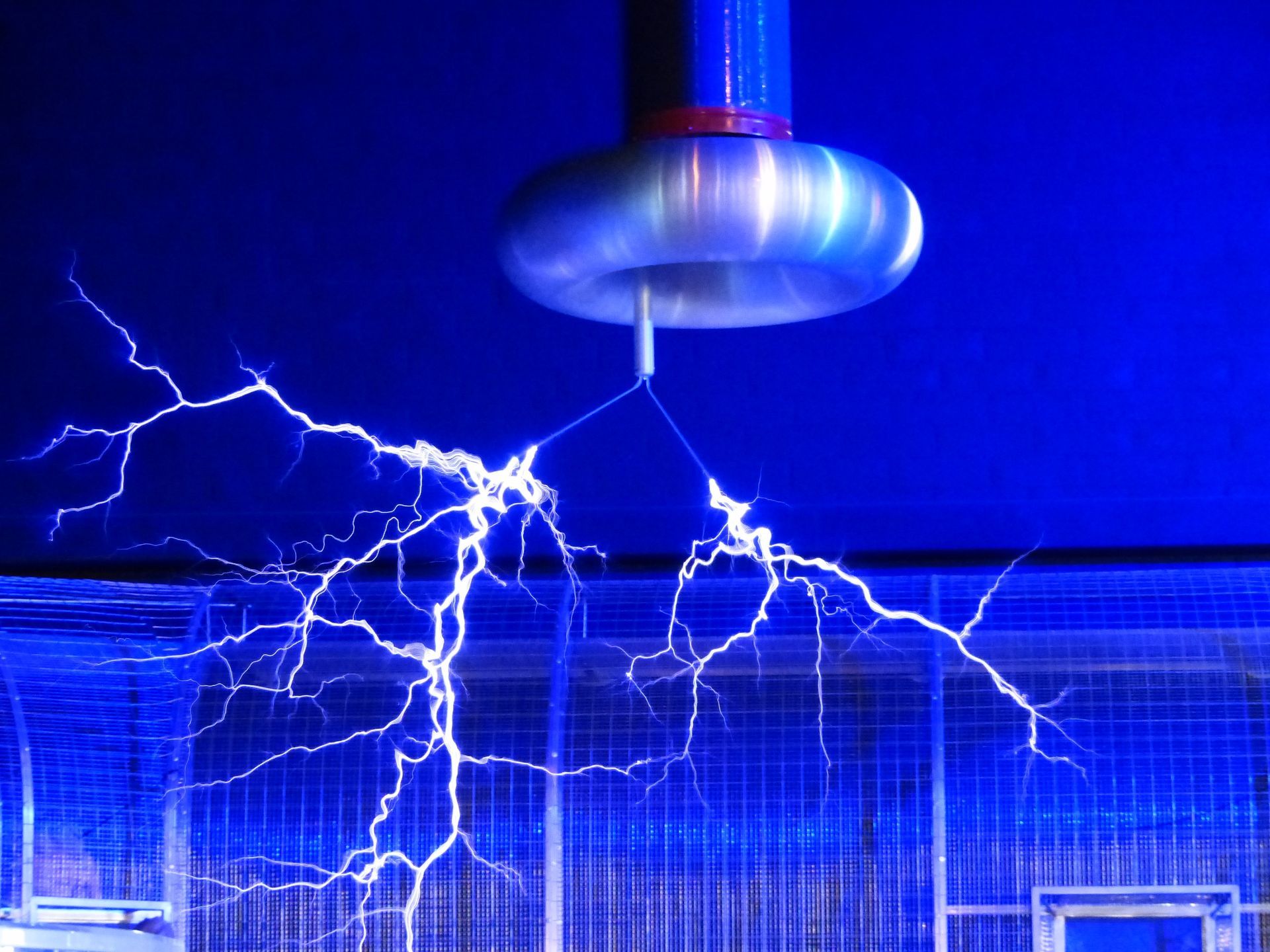
As Einstein’s most famous mathematical statement declares: E=MC^2, Energy equals the constant (mass times the speed of light) with lightspeed squared. Nature displays this action with lightning. When lightning flashes across the sky, it follows the same pattern as Schauberger describes. Lightning’s flow of energy follows nature’s pattern as in the limbs of a tree, a creek bed, or the veins and arteries in a living animal.
These observations point to explain what gravity is: Gravity is identified as the angular momentum of matter along this linear path.
Note for this and other articles*. These articles are opinion based upon empirical analysis.
Disclosure – This author is not a certified doctor
* In this writing, a one-sided conversation known as ‘a paper’, it is recognized that a PhD is an acronym for Doctorate of Philosophy; in a particular subject. The title is awarded to an individual by a select group of academicians to attest to the fact: that individual has proven to the accredited qualifying committee; the individual is capable to hold a credible thought process in a specific subject matter; re: a rational, individualized and separate opinion of philosophy. This author did not complete the fully required academic process and as such, at that time, was not qualified to be honored with an academic review. However, this paper should reveal that the content of its subject matter is philosophically qualified, as a valid opinion, to adhere to the most stringent of hypothesis standards in the field of theoretical subatomic physics.
Some of the author’s articles (papers) occasionally pose multi-dimensional perspective. This positions the use of mathematical combinations with different base numbers, other than 10. This combination presents new perspectives. These philosophical perspectives are written without the common digitization of base 10 mathematics support.
CATTCC.org
Sustainable Transportation