
Maglev Development
An overview of current global maglev development
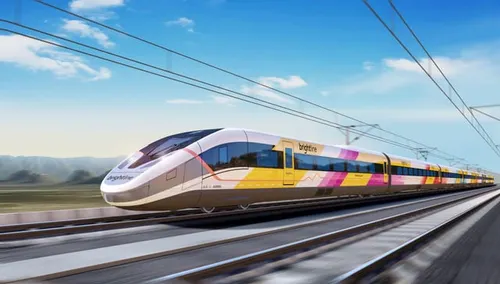
photo credits: China's CRRC4, Siemens' American Pioneer 220 - Brightline West
A quick overview for those unaware of what maglev refers to; maglev is a portmanteau (blending of words) of magnetic levitation.
Maglev is a form of transportation technology using magnetic forces to suspend, guide, and propel vehicles without physically contacting a track (guideway). The magnetic force eliminates rolling resistance and friction. The basic concept is very simple: like magnetic poles repel and opposite poles attract. This allows vehicles to float above a guideway. Maglev systems are primarily categorized into two types: electromagnetic suspension (EMS), which uses attractive forces between magnets on the train and the guideway, and electrodynamic suspension (EDS), which rely on repulsive forces generated by induced currents in conductive materials on the guideway.
Maglev advantages
The primary advantages of maglev transportation include higher top speeds, superior acceleration and deceleration, lower maintenance costs due to reduced wear, improved gradient handling, and significantly lower noise levels compared to conventional railways.
Maglev challenges
Maglev’s largest challenge is due to the technology shift from 200-year-old tradition of heavy-rail train technology and the cost of upgrading to new technology infrastructure.
In spite of the cost challenges, both China and Japan are increasing maglev development due to the technological advantages and significant speed increase.
Maglev development
Although passive maglev technology, utilizing the independence of small vehicle versatility to meet modern transportation demands with phenomenally lower infrastructure costs, China and Japan have chosen to serve their large metropolitan areas with maglev train technology.
China maglev
China’s maglev train technology surpasses global development. The fastest speed ever achieved by a train is 404 mph (650 km/h), recorded by a maglev prototype developed at China's National University of Defense Technology (NUDT) in June 2025. This surpasses the previous record of 375 mph (603 km/h), set by Japan’s JR Central L0 Series superconducting maglev on the Yamanashi test track in April 2015.
China launched its maglev journey in the 1980s, with key institutions like Southwest Jiaotong University and the China Academy of Railway Sciences leading research. The Shanghai Maglev Line, opened in 2004, was the world’s first commercial high-speed maglev, operating at 267 mph.
Japan maglev
Japan began serious research in the 1960s, focusing on both conventional and superconducting maglev systems. The ML series of test vehicles, including the MLU001 and MLX01, achieved speeds exceeding 310 mph. A major 42.8 km test track in Yamanashi Prefecture, completed in phases from 1995 to 2013, enabled the L0-series maglev to set a world record of 375 mph in 2015. Japan is now constructing a commercial Tokyo–Nagoya line, scheduled to open in 2027, with a top speed of 315 mph.
Japan’s SupraTrans is an advanced energy project utilizing flux pinning in high-temperature superconductors to provide self-stabilizing levitation without the need for active electronic control. These advancements show that maglev technology continues to evolve, with the potential to transform both long-distance and urban transportation networks in the future.
Germany maglev
Germany pioneered the concept in the 1920s, with Hermann Kemper patenting a maglev train design in 1934. Research intensified in the 1960s, leading to the development of the TransRapid system using Electromagnetic Suspension (EMS). By the 1980s, Germany had completed a 31.5 km test track in Emsland, achieving speeds over 250 mph with prototypes like TR07. The country also explored low-speed urban applications, including the M-Bahn system in Berlin.
Other maglev development
Global advancements include superconducting maglev systems using high-temperature superconductors (HTS), such as the MagLev-Cobra project in Brazil and research in the U.S. The SwissMetro concept proposes a high-speed EDS system in partially evacuated tunnels. Additionally, evacuated tube technology (ET3), proposed by Darell Oster and further developed by Shen Zhiyun, aims to enable ultra-high-speed travel by reducing air resistance.
Along with anticipation of the cost barriers, come private sector innovation, such as: Ironlev . This maglev technology company has developed a 'passive ferromagnetic levitation' system. It uses magnetic skids that suspend the vehicle by interacting directly with conventional railway tracks. The technology of adaptation to standard railroad significantly reduces fast speeds, however, it provides an excellent opportunity for streetcars in urban areas.
In maglev systems, propulsion is typically provided by a linear motor, and the power required for levitation is generally a small fraction of the total energy used. Since air resistance is the dominant factor of energy consumption at high speeds, two innovative solutions are smaller vehicles and air-evacuated tubes to operate in. ET3 has computer simulated its system technology which exceed 4,000 mph.
At present, maglev technology has the greatest potential as the most efficient form of available modern transportation. Where is it on the global scene of technological development? Currently, there are only seven operational maglev systems worldwide: four in China, two small passenger shuttle systems in South Korea, and one in Japan. The significant projects under construction include the Chūō Shinkansen in Japan, connecting Tokyo and Nagoya with future extensions to Osaka, and a line between Changsha and Liuyang in Hunan Province, China.
What is preventing the development and implementation of maglev technology
Throughout Europe, India, Australia, South America, and North America, the title of corporate kings in mass transit are Siemens and Alstom. Their political lobbying strength enables these two corporate leviathans to own passenger train and transit transportation dominance throughout the world. Between these two companies, they own and supply their technology of every large train and transit system in the world, except for China, Japan, and Russia.
Alstom has been In the US since the 1880s. In 2025 it underwent a major upgrade with the opening of a new state-of-the-art Plant 4 facility, further solidifying its role in U.S. rail manufacturing. Its new factory in Hornell, NY is 45 miles from its “rival” Siemens manufacturing plant in Horsehead, NY.
Alstom operates multiple manufacturing facilities in New York, with its primary passenger rail manufacturing site located in Hornell, New York. Its expansion reshores production from Brazil which establishes Alstom as the largest passenger train manufacture in the United States.
In addition to Hornell, Alstom has a manufacturing presence in Plattsburgh, New York, where it produces rail components and builds modern rail fleets, and in Kanona, New York, which serves as a center for vehicle refurbishment and modernization.
Siemens’ American Pioneer 220 is the name of the high-speed trainset being developed by Siemens Mobility for Brightline West, marking the first true high-speed rail production facility in North America. Designed as an American variant of the Siemens Velaro Novo platform, the trainset is engineered for a maximum speed of 220 mph (354 km/h) and will operate on the Las Vegas to Southern California route, expected to open in 2028.
The American Pioneer 220 trains are being manufactured at a new 300,000 sq ft facility in Horseheads, New York, with production beginning in 2026. The facility, a $60 million investment, will create around 300 skilled jobs, with union representation through the International Association of Machinists and Aerospace Workers (IAM). The 10 seven-car trainsets will be built in compliance with the German owned company’s “Buy America” standards, with major components like traction systems and bogies produced in Sacramento, CA.
Brightline West selected Siemens as the preferred vendor in May 2024 after a competitive procurement process, with the contract including a 30-year maintenance agreement for the trainsets, to be performed at a maintenance facility in Sloan, Nevada. The American Pioneer 220 is designed for interoperability with the California High-Speed Rail system and represents a step into 1800’s U.S. rail infrastructure.
Conclusion
Trains were a wonderful component of Western civilization’s birth. The biggest challenge is how to overcome governments’ political procedure to implement the necessity of modern advanced transportation technology to satisfy the social demands for the technological advanced society.
CATTCC.org
Sustainable Transportation